YouTube Automation Explained: How It Works & How to Do It Right in 2026
YouTube Automation: What It Is, How It Works & How to Do It the Right Way in 2026
Table Of Contents
YouTube Automation: What It Is, How It Works & How to Do It the Right Way in 2026
Faceless Content vs Traditional YouTube Channels
The Role of AI in Modern YouTube Automation
What YouTube Automation Is Not
Is YouTube Automation Allowed?
How YouTube Automation Actually Works (Step-by-Step)
Examples of YouTube Automation Niches
Why the Niche Matters More Than the Tools
Setting the Foundation for the Rest of the System
How Successful Automation Channels Choose Video Topics
The Difference Between Guessing and Research
Understanding Video Formats (Not Just Topics)
Why Virality Is a Bonus — Not a Requirement
Why This Step Is Where Most Beginners Fail
The Bottom Line on Video Topic Research
3. Script Creation (AI-Assisted)
How Scripts Are Created in Modern YouTube Automation
Clear Structure: Guiding the Viewer
Strong Hooks: Winning the First 10 Seconds
Retention-Focused Pacing: Keeping Viewers Watching
Why AI Doesn’t Replace Strategy
The Advantage of AI-Assisted Scriptwriting
The Bottom Line on Script Creation
Common Faceless Video Formats Used in YouTube Automation
Why Faceless Videos Still Perform Well on YouTube
Editing for Retention, Not Perfection
Scaling Video Creation with Systems
No Camera Required — But Quality Still Matters
The Bottom Line on Faceless Video Creation
The Role of Optimization in YouTube Automation
SEO-Friendly Titles That Drive Clicks
Descriptions and Metadata (Supporting, Not Leading)
Watch-Time Focused Video Structure
Consistency: The Hidden Advantage
Turning Videos into Long-Term Assets
The Bottom Line on Uploading & Optimization
Is YouTube Automation Still Profitable in 2026?
Why Most People Fail at YouTube Automation
The Role of AI in YouTube Automation
Is YouTube Automation Allowed?
How Long Does It Take to See Results?
YouTube automation has become one of the most talked-about online business models in recent years and also one of the most misunderstood.
Depending on where you look, you’ll see completely opposite opinions.
Some people claim YouTube automation is dead.
Others insist it never worked in the first place and label it a scam.
And at the same time, there are creators quietly building profitable, faceless YouTube channels using automation and AI — without ever appearing on camera.
So what’s actually true?
The reality is that YouTube automation hasn’t disappeared.
It has evolved.
Early versions of YouTube automation relied heavily on:
Re-uploaded content
Low-effort videos
Copyright-grey tactics
Outsourcing everything with little quality control
That era did die — and for good reason.
What replaced it is a far more refined model focused on:
Original content
Systemised workflows
Data-driven topic selection
AI-assisted production
Long-term channel growth
In other words, YouTube automation today looks very different from what most people imagine when they hear the term.
Modern YouTube automation is not about pressing a button and making money overnight.
It’s about building a repeatable content system that allows you to publish high-quality videos consistently — without needing to be the face of the channel.
This is why the topic causes so much confusion.
People who tried outdated or low-quality approaches often conclude that automation “doesn’t work,” while creators who understand how YouTube actually rewards content are still seeing results behind the scenes.
In this guide, you’ll get a clear, realistic breakdown of how YouTube automation works in 2026 — without hype, shortcuts, or false promises.
Specifically, you’ll learn:
What YouTube automation really is (and what it isn’t), so you can separate legitimate systems from outdated tactics
How automated YouTube channels actually work, step by step, from niche selection to publishing
Why most people fail with YouTube automation, even when they use AI tools
How creators are using AI the right way in 2026 to speed up workflows while staying compliant with YouTube’s rules
By the end of this guide, you’ll understand whether YouTube automation is a good fit for you — and what it actually takes to do it properly.
Let’s break it down.
What Is YouTube Automation?

YouTube automation is a content creation model where you run a YouTube channel without appearing on camera, by systemising and automating most — or all — of the production workflow.
Rather than filming yourself, speaking to the camera, or building a personal brand, YouTube automation focuses on creating faceless content using repeatable systems. These systems allow a channel to publish consistently while minimizing manual effort and time investment.
At its core, YouTube automation is about process, not shortcuts.
Instead of relying on creativity alone, automation channels follow a structured framework for every video. This makes it possible to scale content output, test what works, and improve performance over time.
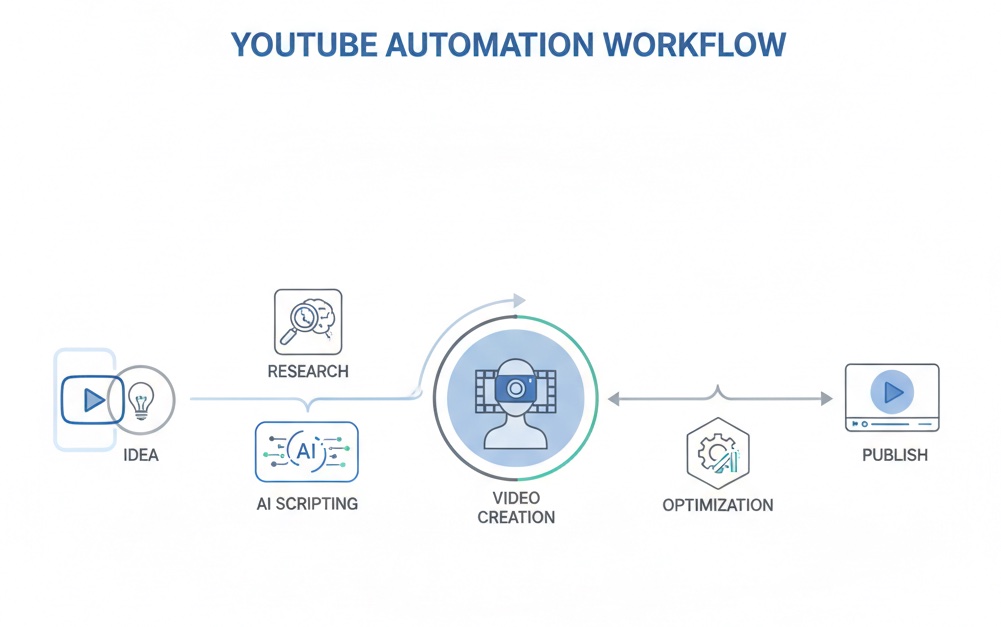
A typical YouTube automation workflow includes:
Researching video ideas using data and proven formats rather than guesswork
Writing scripts designed to hook viewers and maintain attention
Creating visuals or footage without filming on camera
Editing videos using a repeatable style and structure
Publishing content consistently according to a clear schedule
Because each step follows a system, the process becomes faster and more efficient with every upload.
Faceless Content vs Traditional YouTube Channels
Traditional YouTube channels rely heavily on:
Personality
On-camera presence
Filming setups
Personal branding
YouTube automation channels, on the other hand, remove these barriers.
This makes the model especially appealing for people who:
Don’t want to be on camera
Prefer building systems over personal brands
Want flexibility and scalability
Are focused on long-term assets rather than short-term attention
Automation doesn’t remove effort — it redirects it.
The Role of AI in Modern YouTube Automation
In modern YouTube automation, AI tools handle a large portion of the workflow, making it possible for one person to run a channel efficiently without a full team.
AI is commonly used for:
Script drafting and ideation
Improving storytelling and structure
Speeding up editing workflows
Creating or enhancing visuals
Batch-producing content at scale
This doesn’t mean content is mindlessly generated.
Successful creators use AI as a productivity tool, not a replacement for strategy or quality control. Human oversight is still essential — especially when it comes to:
Topic selection
Video structure
Viewer retention
Compliance with YouTube guidelines
When used correctly, AI simply allows creators to do more in less time.
What YouTube Automation Is Not
One of the biggest misconceptions about YouTube automation is that it involves:
Bots
Fake engagement
Re-uploaded content
Copyright abuse
“Set-and-forget” income
None of these are required — and most of them will actively harm a channel.
YouTube automation is not about gaming the system. It’s about working with YouTube’s algorithm by producing original, engaging content that keeps viewers watching.
Is YouTube Automation Allowed?
Yes — when done properly.
YouTube allows:
Faceless channels
AI-assisted content creation
Stock footage and licensed visuals
Automated workflows
What YouTube does not allow are:
Re-uploads of copyrighted content
Low-effort spam content
Misleading or deceptive videos
Artificial engagement manipulation
As long as content is original, valuable, and compliant, YouTube automation is fully within YouTube’s rules.
The Bottom Line
YouTube automation is best understood as a business model, not a trick.
It replaces guesswork with systems, manual effort with smart tools, and inconsistent posting with structured workflows. When combined with AI and a long-term mindset, it allows creators to build faceless YouTube channels that can grow and monetize over time.
How YouTube Automation Actually Works (Step-by-Step)

A legitimate YouTube automation system follows a clear, repeatable structure. While the tools and workflows may change over time, the underlying process stays the same.
Successful automation channels aren’t built on shortcuts — they’re built on systems.
Each step below plays a critical role. If one is skipped or rushed, the entire channel suffers.
1. Niche Selection
The first and most important step in YouTube automation is choosing the right niche.
No amount of AI, editing, or optimization can save a channel that’s built in the wrong niche. This is where most beginners make their biggest mistake — they focus on tools and tactics before choosing a niche that actually works for faceless content.
A strong YouTube automation niche must meet three key criteria:
It has proven demand
People are already watching this type of content. You’re not trying to “educate the market” or invent a new trend — you’re plugging into existing viewer behavior.It works well for faceless content
The videos don’t rely on a personal brand, personality, or on-camera presence. The value comes from information, storytelling, or explanation — not the creator’s face.It can generate ad revenue consistently
Advertisers are actively spending money in this space, which impacts RPMs and long-term monetization potential.
This combination is what allows automation channels to grow steadily over time.
Examples of YouTube Automation Niches
Some niches are naturally better suited to automation than others. While this list isn’t exhaustive, the following categories consistently perform well for faceless channels:
Facts & storytelling
These channels rely on curiosity, narratives, and interesting information. They often perform well because viewers are motivated to watch until the end.Finance & business education
Topics related to money, business, and personal finance tend to attract high-value advertisers and strong viewer interest when done responsibly.Motivational content
Motivation channels can work well when they focus on storytelling, lessons, and emotional engagement rather than generic quotes.Explainer-style videos
These channels break down complex ideas into simple, digestible formats. They work especially well for evergreen topics.Evergreen informational topics
Content that remains relevant year after year — such as “how things work” or “why things happen” — is ideal for long-term automation channels.
The key pattern here is repeatability. These niches allow you to publish similar video formats consistently without needing constant reinvention.
Why the Niche Matters More Than the Tools
Many beginners make the mistake of starting with tools:
AI script writers
Video generators
Editing software
Automation platforms
While tools can save time, they don’t create demand.
A well-chosen niche with a simple workflow will outperform a poorly chosen niche with the most advanced tools available.
When the niche is right:
Video ideas are easier to find
Retention is easier to achieve
Monetization happens more naturally
Scaling becomes possible
This is why experienced creators always start with niche and strategy first, and automation second.
Setting the Foundation for the Rest of the System
Once the niche is locked in, every other step becomes easier:
Video topics align naturally with audience interests
Scripts follow predictable structures
Visual styles stay consistent
Upload schedules become sustainable
In many ways, niche selection determines the ceiling of the channel.
Get this step right, and YouTube automation becomes a system you can refine and scale. Get it wrong, and even the best execution will struggle.
2. Video Topic Research
Successful YouTube automation channels don’t guess video ideas.
They don’t upload randomly, hope for the best, or rely on “creative inspiration.” Instead, they treat video ideas as data points, not experiments.
This step alone is where most beginners go wrong — not because they lack effort, but because they underestimate how important topic selection really is.
On YouTube, the topic of the video matters before the thumbnail, before the title, and before the editing.
If the topic doesn’t already have proven demand, everything else becomes an uphill battle.
How Successful Automation Channels Choose Video Topics
Rather than trying to reinvent the wheel, profitable automation channels follow a proven, repeatable approach to topic research.
They focus on three core principles:
Analyze what’s already working
Instead of asking, “What should I make a video about?”, they ask, “What videos are already performing well in this niche?”Identify viral or high-performing formats
They look for patterns — not one-off viral hits. If a format works repeatedly across multiple channels, it’s a strong signal.Adapt proven ideas rather than copying blindly
The goal isn’t duplication. It’s understanding why a video worked and recreating that structure with original content.
This approach dramatically increases the odds that a new video will gain traction.
The Difference Between Guessing and Research
Beginners often:
Upload videos based on personal interest
Choose topics they think people will like
Copy random titles without context
Chase trends without understanding demand
Experienced automation creators do the opposite.
They:
Study top-performing channels in their niche
Track which topics generate consistent views
Notice recurring themes and angles
Build content around proven viewer behavior
One well-researched topic can outperform dozens of poorly chosen ones.
Understanding Video Formats (Not Just Topics)
A common mistake is focusing only on the topic instead of the format.
For example:
“How money works” is a topic
“Why most people stay broke (and how the rich think differently)” is a format
Formats include things like:
“Why X happens”
“The real reason behind X”
“What no one tells you about X”
“X explained simply”
“X vs Y: which is better?”
Successful YouTube automation channels reuse formats that are already proven to generate clicks and watch time.
This is especially important for faceless channels, where structure and storytelling replace personality.
Why Virality Is a Bonus — Not a Requirement
Many people associate YouTube automation with going viral.
While viral videos can accelerate growth, they’re not required for success.
Strong automation channels focus on:
Consistent view velocity
Solid watch time
Evergreen topics that compound over time
A channel that publishes well-researched videos consistently will often outperform one chasing occasional viral spikes.
The key is repeatable performance, not one-hit wonders.
Using Data to Reduce Risk
Video topic research dramatically reduces the risk of failure.
Instead of wondering:
“Will this video work?”
You’re asking:
“This already works — how do I execute it better?”
This mindset shift is critical.
It turns YouTube automation from a guessing game into a system — and systems are what allow channels to scale.
Why This Step Is Where Most Beginners Fail
Most beginners fail with YouTube automation not because they lack effort or tools, but because they skip research.
They:
Start uploading too quickly
Don’t validate ideas
Focus on production over strategy
Get discouraged when videos underperform
Without proper topic research, even high-quality videos can struggle to get traction.
With it, even simple videos can perform extremely well.
The Bottom Line on Video Topic Research
Video topic research is the foundation of successful YouTube automation.
When done correctly, it:
Increases the likelihood of views
Improves watch time
Speeds up growth
Reduces frustration and wasted effort
It’s not about creativity — it’s about clarity and consistency.
3. Script Creation (AI-Assisted)
In YouTube automation, scripts are the backbone of every video.
No matter how good the visuals or editing are, a weak script will kill retention — and without retention, YouTube won’t push the video.
This is why successful automation channels treat script creation as a strategic process, not an afterthought.
How Scripts Are Created in Modern YouTube Automation
In modern YouTube automation, scripts are typically created using AI tools combined with human direction.
AI dramatically speeds up the writing process, but it doesn’t replace strategy or understanding viewer psychology. Instead, it acts as a force multiplier — allowing creators to produce more content without sacrificing structure or quality.
Effective automation scripts are built around three core elements:
Clear structure
Strong hooks
Retention-focused pacing
Each of these plays a critical role in how long viewers stay watching.
Clear Structure: Guiding the Viewer
Every high-performing script follows a clear, logical structure.
Viewers should always know:
What the video is about
Why they should keep watching
What they’ll learn by the end
A common structure used in automation channels includes:
A compelling opening hook
A brief setup or context
The main content broken into clear segments
A strong ending that resolves the promise made at the start
This structure keeps viewers oriented and reduces drop-off.
AI can help generate drafts quickly, but the structure is what ensures the script actually performs.
Strong Hooks: Winning the First 10 Seconds
The first few seconds of a video are critical.
Most viewers decide whether to keep watching within the first 5–10 seconds, which makes the opening hook one of the most important parts of the script.
Strong hooks typically:
Create curiosity
Challenge a common belief
Promise a clear payoff
Set up an open loop
For example, instead of starting with a generic introduction, effective automation scripts immediately pull the viewer into the core idea.
AI tools can generate multiple hook variations quickly, allowing creators to test and refine what works best for their niche.
Retention-Focused Pacing: Keeping Viewers Watching
Retention isn’t just about what you say — it’s about how you say it.
Successful scripts:
Avoid long, slow introductions
Deliver value early
Use short, clear sentences
Introduce new ideas regularly to reset attention
AI helps speed up drafting, but human oversight ensures the pacing feels natural and engaging rather than robotic.
The goal is to constantly give the viewer a reason to stay.
Why AI Doesn’t Replace Strategy
One of the biggest misconceptions about YouTube automation is that AI can “do everything.”
In reality:
AI can write faster
AI can suggest ideas
AI can improve efficiency
But AI does not understand:
Your audience’s specific pain points
Why certain videos outperform others
How YouTube retention actually works in practice
That’s why AI doesn’t replace strategy — it amplifies it.
Creators who understand content psychology and use AI intelligently consistently outperform those who rely on AI alone.
The Advantage of AI-Assisted Scriptwriting
When used correctly, AI-assisted scriptwriting allows automation channels to:
Batch content efficiently
Maintain consistent quality
Test multiple ideas quickly
Scale without burning out
Instead of spending hours writing from scratch, creators can focus on:
Refining hooks
Improving pacing
Aligning scripts with proven video formats
This is what turns YouTube automation into a sustainable system rather than a grind.
The Bottom Line on Script Creation
Scripts are not just words on a page — they’re the engine of viewer retention.
AI makes script creation faster, but structure, hooks, and pacing are what make videos perform. When these elements work together, automation channels can publish consistently without sacrificing quality or engagement.
4. Video Creation (Faceless)

One of the biggest advantages of YouTube automation is the ability to create high-quality videos without ever appearing on camera.
Faceless video creation removes many of the traditional barriers to starting a YouTube channel:
No filming setup
No expensive camera equipment
No lighting
No on-screen personality
No personal branding pressure
This makes YouTube automation especially appealing to people who prefer working behind the scenes or want to build a scalable system rather than a personal brand.
Common Faceless Video Formats Used in YouTube Automation
Depending on the niche, automation channels use a variety of faceless video formats. The key is choosing a format that complements the script and keeps viewers engaged.
Some of the most common formats include:
Stock footage
Licensed stock clips are often used to visually support the script. When selected carefully and edited properly, stock footage can feel cohesive and professional rather than generic.AI-generated visuals
AI tools can generate custom visuals, images, or short clips that match the narrative of the video. This allows for more originality and faster production without manual design work.Screen recordings
Screen captures are commonly used in explainer-style or educational videos, especially in niches like software, business, or tutorials.Animated or explainer-style formats
Simple animations, motion graphics, and text-based visuals help explain complex ideas clearly while maintaining viewer attention.
Each of these formats can be mixed and matched depending on the content style and niche.
Why Faceless Videos Still Perform Well on YouTube
A common concern is whether faceless videos can compete with personality-driven channels.
The answer is yes — when the content delivers value.
YouTube’s algorithm prioritizes:
Watch time
Viewer retention
Engagement
It does not require a face on screen.
If a video:
Hooks the viewer
Delivers on its promise
Keeps attention through the end
YouTube will continue recommending it — regardless of whether there’s a person on camera.
Editing for Retention, Not Perfection
Faceless automation videos don’t need flashy edits to perform well.
What matters more is:
Clear visuals that support the script
Consistent pacing
Smooth transitions
Visual variety to avoid boredom
Successful automation channels focus on clarity and flow, not overproduction.
Simple, clean editing that complements the narration is often more effective than overly complex visuals.
Scaling Video Creation with Systems
Because faceless video creation follows a repeatable process, it’s easy to:
Batch videos
Maintain a consistent visual style
Improve efficiency over time
Once a format is established, creating new videos becomes faster and more predictable. This consistency helps YouTube understand the channel and improves long-term performance.
No Camera Required — But Quality Still Matters
While faceless automation removes the need for filming, it does not remove the need for quality.
Low-effort visuals, random clips, or mismatched footage can still hurt retention.
The goal is to create videos that feel intentional, cohesive, and valuable — even without a face on screen.
The Bottom Line on Faceless Video Creation
Faceless video creation is one of the core reasons YouTube automation is scalable.
By removing the need for on-camera presence, creators can focus on systems, storytelling, and consistency. When paired with strong scripts and thoughtful editing, faceless videos can perform just as well — if not better — than traditional talking-head content.
5. Uploading & Optimization
Creating videos is only half the equation.
Titles, descriptions, thumbnails, and consistency are what turn YouTube videos into long-term traffic assets. This is where YouTube automation channels quietly outperform most casual creators.
Instead of treating each upload as a one-off, automation channels treat videos like compounding assets that improve the channel over time.
The Role of Optimization in YouTube Automation
YouTube’s algorithm doesn’t “watch” videos — it reacts to viewer behavior.
This means every upload sends signals based on:
Click-through rate (CTR)
Watch time
Audience retention
Engagement
Optimization exists to improve those signals.
When done correctly, it helps YouTube understand:
Who the video is for
When to recommend it
How often to show it
Proven Thumbnail Frameworks
Thumbnails are the first thing a viewer sees.
Successful automation channels don’t design random thumbnails — they use proven frameworks that consistently earn clicks.
Effective thumbnails typically:
Communicate one clear idea
Avoid clutter
Use contrast to stand out
Pair visually with the title (without repeating it)
The goal isn’t to be artistic — it’s to be clear and compelling.
Automation channels often test or reuse thumbnail styles that have already proven to work, creating visual consistency across the channel.
SEO-Friendly Titles That Drive Clicks
Titles play two roles:
Helping YouTube understand the topic
Convincing a human to click
Strong titles are:
Clear
Curiosity-driven
Aligned with proven formats
Relevant to what people are already watching or searching for
Automation channels often use variations of:
“Why X Happens”
“The Truth About X”
“How X Really Works”
“X Explained Simply”
The title sets the expectation — and the video must deliver on it.
Descriptions and Metadata (Supporting, Not Leading)
Descriptions and tags support discovery, but they’re not the primary growth driver.
Automation channels use descriptions to:
Reinforce the topic
Add context for YouTube
Include relevant keywords naturally
Improve discoverability over time
This step helps YouTube categorize the video correctly, especially in the early stages of a channel.
Watch-Time Focused Video Structure
Optimization doesn’t stop at the upload screen.
The internal structure of the video plays a huge role in performance.
Automation channels intentionally design videos to:
Hook viewers early
Avoid long intros
Deliver value quickly
Maintain momentum throughout
If viewers stay longer, YouTube promotes the video more — simple as that.
Consistency: The Hidden Advantage
Consistency is one of the most underrated advantages of YouTube automation.
Because the workflow is systemised, automation channels can:
Upload on a predictable schedule
Maintain a consistent format
Train the algorithm faster
This consistency helps YouTube:
Understand the channel’s niche
Recommend videos to the right audience
Build momentum over time
Even average videos can perform well when published consistently within a proven framework.
Turning Videos into Long-Term Assets
Unlike social media posts that disappear quickly, optimized YouTube videos can:
Generate views for months or years
Continue earning ad revenue
Compound traffic over time
This is what separates YouTube automation from short-term content strategies.
Each video builds on the last.
The Bottom Line on Uploading & Optimization
Uploading a video isn’t the finish line — it’s the starting point.
Automation channels win by combining:
Proven thumbnail frameworks
SEO-friendly, click-worthy titles
Watch-time focused video structure
Consistent publishing
When these elements work together, videos stop being uploads and start becoming assets.
Is YouTube Automation Still Profitable in 2026?
Yes — but only if done correctly.
What killed YouTube automation wasn’t YouTube.
It was:
Low-effort content
Re-uploads
Copyright abuse
Poor video quality
Unrealistic expectations
What still works is:
Original content
Value-driven videos
AI-assisted workflows
Long-term consistency
Many channels are still earning daily ad revenue with zero on-camera presence.
Why Most People Fail at YouTube Automation
Here’s the honest truth.
Most people fail because they:
Copy random videos without understanding why they worked
Choose saturated or dying niches
Focus on tools instead of strategy
Quit after 10–20 uploads
Expect instant results
YouTube automation is not “set and forget.”
It’s systemise and scale.
The Role of AI in YouTube Automation
AI has completely changed how automation works.
In 2026, creators are using AI to:
Generate scripts faster
Improve storytelling
Speed up editing
Create visuals
Batch content efficiently
This doesn’t mean “push a button and get rich.”
It means:
One person can now do what previously required a full team.
That’s the real advantage.
Is YouTube Automation Allowed?
Yes — when done properly.
YouTube allows:
Faceless channels
AI-assisted content
Stock footage
Automated workflows
What YouTube does not allow:
Re-uploads
Copyright infringement
Low-effort spam content
Misleading or deceptive videos
Automation is a workflow choice — not a loophole.
How Long Does It Take to See Results?
This depends on:
Niche
Consistency
Content quality
Strategy
Most successful channels:
Upload consistently for 30–90 days
Improve based on data
Focus on long-term growth
Virality accelerates results — but it’s not required to start earning.
The Smart Way to Start YouTube Automation
If you’re serious about YouTube automation, the goal should be:
Build a repeatable system
Use AI to save time (not cut corners)
Focus on content quality and retention
Play the long game
That’s exactly how modern automation channels are built.
Want a Step-by-Step System?
If you want to learn how to build a faceless AI YouTube channel from scratch, with:
Proven video formats
AI-powered workflows
Clear daily actions
No filming required
Then you’ll want to check out the 30 Day AI Viral Challenge.
It walks you through the entire process — step by step — so you’re not guessing or wasting time.
👉 Join The 30 Day AI Viral Challenge
Final Thoughts
YouTube automation isn’t dead.
It’s just grown up.
And in 2026, the creators who win are the ones who:
Use AI intelligently
Focus on quality
Build systems — not shortcuts
