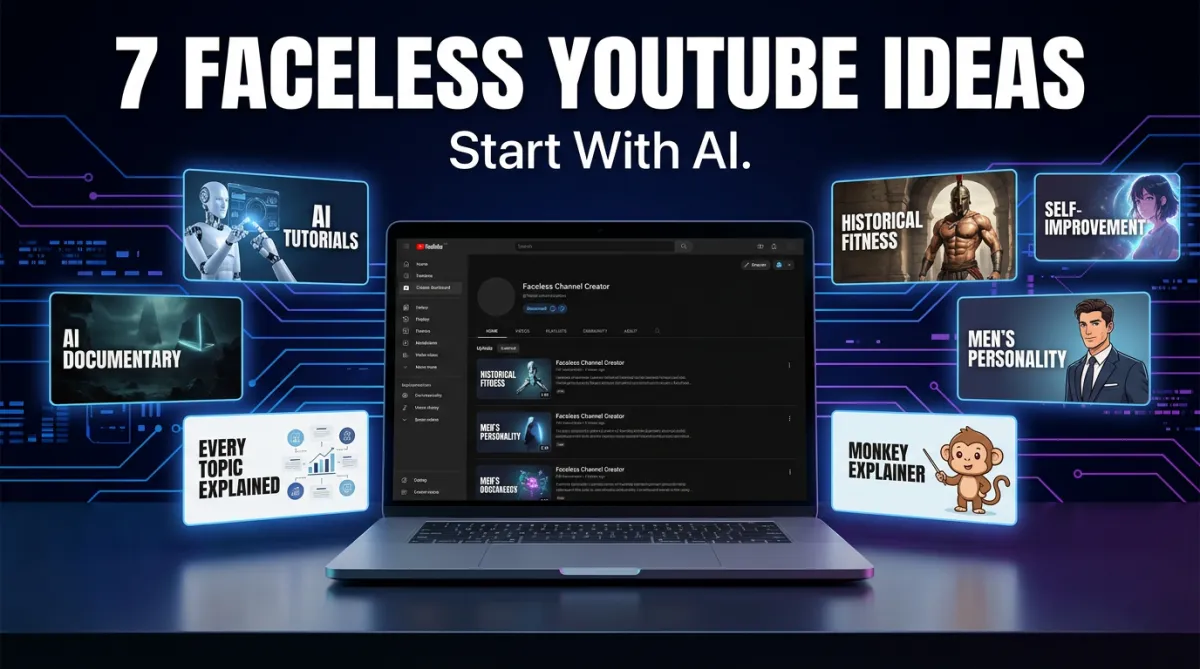
7 Faceless YouTube Channel Ideas You Can Start With AI in 2026
7 Faceless YouTube Channel Ideas You Can Start With AI in 2026
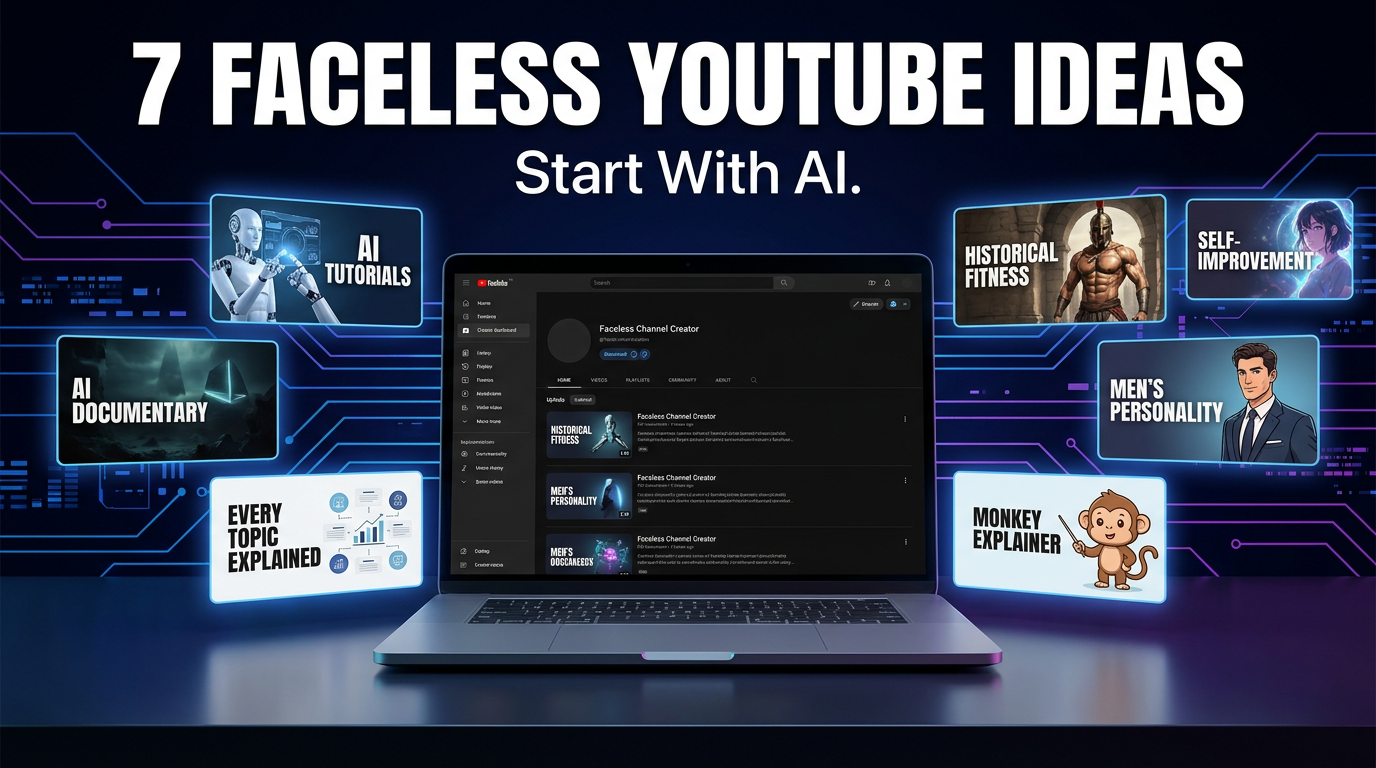
Faceless YouTube channels are one of the easiest ways to start creating content without showing your face, recording yourself on camera, or building a personal brand from scratch. And in 2026, AI tools have made the whole process faster than ever.
You can now generate scripts, voiceovers, visuals, thumbnails, and even short video clips using tools like ChatGPT, ElevenLabs, AI image generators, and AI video editors. But making videos isn't the hard part anymore.
The real challenge is choosing the right faceless YouTube channel idea.
Some niches are too competitive. Some are nearly impossible to monetize. Some chase trends that vanish in a week. But there are still plenty of faceless channel ideas that are evergreen, scalable, and genuinely beginner-friendly — and most "ideas" lists won't show you these.
Below are seven faceless YouTube channel ideas you can start with AI, plus practical tips for making videos that actually get watched.
Why Faceless YouTube Channels With AI Work So Well
Before the ideas, it helps to understand why this model works — because that's what tells you which niche to pick.
A faceless channel removes the two biggest barriers that stop most people from starting: being on camera and producing content fast enough to stay consistent. AI removes the second barrier almost entirely. You can research a topic, script it, narrate it, and assemble visuals in a fraction of the time it used to take.
That creates a real opportunity, but it also creates a flood of low-effort, copy-paste content. The channels that win aren't the ones using AI the most. They're the ones pairing AI with a strong idea, a clear repeatable format, and good packaging. Keep that in mind as you read — the niche matters, but the angle you take inside it matters more.
1. AI Tutorials
AI tutorials are one of the strongest faceless YouTube channel ideas right now, because new tools, trends, and features appear almost weekly.
The strategy is simple: find AI trends getting attention on social media, then create simple tutorials showing people how to do them.
If AI avatars, AI image animation, or AI voice cloning starts trending, you create a step-by-step tutorial explaining exactly how it's done. This works because people are actively searching for it. They don't want entertainment — they want a solution, which means high intent and strong watch time.
A faceless AI tutorial channel can be built with:
Screen recordings
AI-generated voiceovers
Basic editing (cuts, zooms, captions, highlights)
Text overlays
Simple examples and demonstrations
Screen recording is your secret weapon here, because it makes the content feel original and authentic. Even with an AI voiceover, the viewer can see the tutorial is practical and real. Use a tool like ElevenLabs for a polished voice.
The key is speed. When a new AI trend takes off, publish your tutorial quickly while people are still searching for it.
2. Historical Fitness
Fitness is one of the most competitive niches on YouTube — but historical fitness gives it a unique, curiosity-driven twist.
Instead of another generic "how to build muscle" video, this niche focuses on how people trained throughout history. Video ideas include:
How ancient warriors trained
What 1800s strongmen actually ate
Roman soldier workouts
Spartan fitness routines
Old-school bodybuilding diets
Forgotten training methods from history
This works because it combines two proven content categories — fitness and history. The viewer gets useful information packaged in a more interesting way.
Thumbnails carry a lot of weight in this niche. A clean white background, a striking historical character, and two or three bold words perform well: "Roman Strength," "Spartan Diet," "Ancient Workout," "Strongman Secrets."
To create it, research competitor channels and find topics already performing. Then write a human-style script, structure it with AI, generate the voiceover, and use a mix of AI visuals, stock footage, and text overlays. Study storytelling, topic selection, and thumbnail style above all else.
3. Inspiration and Self-Improvement
Self-improvement is saturated, but it still works when the presentation feels fresh. The angle performing well right now is self-improvement aimed at Gen Z using cartoon, anime, or stylized visuals.
Instead of stock footage of people running or staring out windows, this style uses visually engaging clips and relatable topics:
Why you feel behind in life
How to stop wasting your potential
Habits that quietly destroy your confidence
How to rebuild yourself in 30 days
Why discipline feels impossible
How to become more attractive without trying too hard
This works because self-improvement is emotionally driven. People click because they feel stuck, lost, or ambitious. The distinctive visuals make your video stand apart from the thousands of identical motivational uploads.
Use ElevenLabs (or similar) for voiceovers, and generate your own anime-style clips with AI to avoid copyright issues rather than reusing existing footage. The goal is to make the video feel emotionally relevant to the exact audience you're targeting.
4. Men's Personality
Men's personality is close to self-improvement but narrows in on male identity, confidence, attraction, social skills, and behavior. The tighter focus is the advantage.
Instead of broad videos like "How to Improve Yourself," you make:
Traits that make a man instantly respected
Signs you have a strong personality
Habits that make men look weak
How quiet men become powerful
Why people stop respecting you
How to become mentally untouchable
The ideas don't have to be brand new — what matters is the packaging. Familiar advice presented with unique visuals, strong titles, and a clear point of view still feels fresh.
This niche typically uses 2D characters, anime-style visuals, dark or dramatic thumbnails, short punchy text, and strong emotional hooks. Study channels already winning here, then build your own version with a slightly different angle or audience.
5. Monkey Explainer Videos
Monkey explainer videos are a newer format where a simple 2D monkey character explains a concept or moves through a relatable situation. The niche can vary — self-improvement, science, psychology, education, productivity — but the format itself is the opportunity.
A video might open with: "Monkey has an exam in three days. For reasons unknown to Monkey, he has left all his revision until the last minute."
It works because it's simple, funny, visual, and easy to follow. The character becomes a storytelling device — instead of telling viewers what to do, you show a character experiencing the problem. Great topics include:
Why people procrastinate
How dopamine controls your habits
Why saving money feels hard
How social anxiety works
Why people stay addicted to their phones
How sleep affects your brain
You need one consistent character (drawn simply or generated with AI), then reuse it as a reference across scenes. Scripting matters most: viewers should understand the video visually, not just through narration. Think in frames — each moment should tell part of the story.
6. "Every Topic Explained" Channels
This idea is less a niche and more a repeatable format: take one broad topic, break it into parts, and explain each part in a single video.
Examples:
Every major religion explained
Every generation and their struggles explained
Every type of investor explained
Every social media platform explained
Every productivity system explained
Every personality type explained
It works because the title promises a complete overview — the viewer feels they'll understand an entire topic in one sitting. The format fits almost any niche: finance, tech, history, health, psychology, business, education, culture.
Editing can stay simple: AI-generated images, PNGs, text, basic animation, and a voiceover. The "Every X Explained" title structure does most of the heavy lifting — it instantly feels complete, useful, and clickable. It's ideal if you want a repeatable content system instead of inventing new video concepts every week.
7. AI Documentary Channels
AI documentary channels use AI-generated visuals, AI voiceovers, dramatic editing, and eye-catching thumbnails to tell stories or explain fascinating topics. Possible niches:
Strange history
Lost civilizations
Future technology
Space mysteries
Crime stories
War history
Business documentaries
This niche is powerful because documentary-style content feels high-value. Even when made with AI tools, viewers feel like they're watching something deeper and more polished.
Thumbnails are critical here — bold colors, dramatic faces, cinematic scenes, and strong curiosity hooks: "The City That Vanished," "The Man Who Fooled Everyone," "The Empire Nobody Talks About."
This takes more work than the others because storytelling is everything. You need a strong hook, clear structure, good pacing, and visuals that hold attention. Done well, AI documentary channels feel genuinely premium.
How to Make Faceless YouTube Videos With AI
Choosing the niche is only step one. How you make the videos matters just as much. A few principles separate channels that grow from channels that stall.
Use AI, But Keep the Content Original
AI helps you create faster, but originality is what makes people watch and subscribe. Add it through better topic selection, stronger hooks, unique visuals, clearer examples, better pacing, and a specific audience angle. Don't paste generic AI scripts — they sound flat. Use AI to structure and sharpen your ideas so the final video feels human and specific.
Study Competitors Before Choosing Topics
Before filming, study what's already working: which topics get the most views, which thumbnails stand out, which title formats repeat, how videos open, how long they run, and which audience they target. You don't copy a channel — you understand why it works, then do your own version.
Focus on the Hook
The first 10 seconds decide whether someone keeps watching. A strong hook creates curiosity, urgency, a problem, a surprising claim, a clear benefit, or a pattern interrupt.
Instead of: "Today we're going to talk about fitness in history," open with: "Ancient warriors built terrifying strength without gyms, protein powder, or modern equipment. So what were they doing differently?"
Use Consistent Visual Branding
Faceless channels grow faster when videos feel cohesive. You don't need identical thumbnails, but viewers should recognize your style through similar layouts, colors, characters, title structures, voiceover tone, and editing pace. That's what turns a feed of random videos into a real brand.
Keep Editing Simple But Engaging
You don't need advanced editing to start. Good pacing beats fancy effects. Use text overlays, zooms, scene changes, stock footage, AI images, AI clips, sound effects, captions, and simple motion graphics — enough to keep viewers visually engaged without making the video feel messy.
Frequently Asked Questions
Are faceless YouTube channels still worth it in 2026? Yes. With AI handling scripting, voiceovers, and visuals, the barrier to entry has never been lower, and demand for evergreen explainer and tutorial content keeps growing. The opportunity is real — the winners are simply the ones who pick one idea and stay consistent.
Can you really start a faceless YouTube channel with no experience? You can. AI tools like ChatGPT (scripting), ElevenLabs (voiceovers), and AI image and video generators (visuals) handle the technical work, so you can focus on choosing strong topics and writing good hooks.
Which faceless YouTube niche is easiest for beginners? AI tutorials and "Every X Explained" channels are the most beginner-friendly, because they rely on a simple, repeatable format and high-intent search traffic rather than advanced storytelling or animation skills.
Do faceless YouTube channels make money? They can, through ad revenue, affiliate marketing, sponsorships, and selling your own products or services. Educational and finance-adjacent niches tend to earn higher ad rates, but earnings depend far more on consistency and packaging than on the niche alone.
What AI tools do you need to start? At minimum: a script tool (ChatGPT), a voiceover tool (ElevenLabs), and an image or video generator. A simple editor for cuts, captions, and zooms rounds out the basics.
Final Thoughts
Faceless YouTube channels are still a huge opportunity, especially now that AI makes content creation faster and easier than ever. But the channels that win aren't just the ones using AI — they're the ones using AI with a strong idea, a clear format, good packaging, and consistent execution.
If you're starting out, pick one of these seven faceless YouTube channel ideas and study what's already working in that niche. Then build your own version with better hooks, cleaner thumbnails, stronger storytelling, and consistent uploads.
The best faceless channel ideas aren't always brand new. Often the real opportunity is taking a proven niche and presenting it in a fresher, more interesting way.
To begin your Faceless AI YouTube journey join The 30 Day AI Viral Challenge today.
